Doubting Thomas: Doubt, Confession, and the Faith of John 20
Thematic Summary
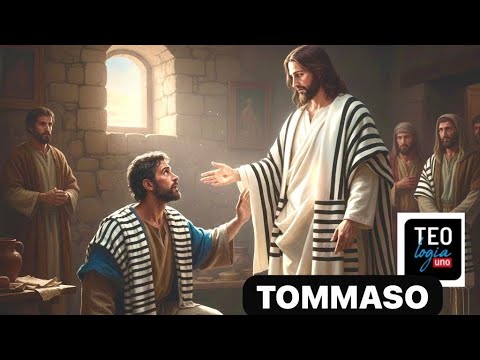
Doubting Thomas, called Didymus ("twin"), is the apostle who in John 20 asks to see and touch the wounds of the Risen One before believing (John 20:24-25). Absent at the first appearance, he is no cynic: the other disciples too had struggled to believe (Luke 24:36-43). Eight days later, before Christ who invites him to touch, Thomas utters the highest Christological confession of the Gospels: "My Lord and my God" (John 20:28), attributing to Jesus the divine Name. Jesus responds with the beatitude "blessed are those who have not seen and yet have believed" (John 20:29), which founds the faith of every later believer. Tradition calls him a missionary in India; he must be distinguished from the "Gospel of Thomas," a second-century Gnostic apocryphon not written by the apostle.
Who Was Thomas? 'Didymus' (The Twin) and His Character in the Gospels
Who Was Thomas in the Bible
To answer who was Thomas in the Bible, we must begin with his name: the Aramaic Te'oma (תְּאוֹמָא) and the Greek Dídymos (Δίδυμος) both mean "twin." Hence the phrase Thomas the twin apostle, by which the Fourth Gospel identifies him (John 11:16; 20:24). Thomas the apostle belongs firmly to the group of the Twelve: his name appears in all the Synoptic apostolic lists (Matthew 10:3; Mark 3:18; Luke 6:15), as well as in Acts (Acts 1:13). It is John, however, who gives him a portrait of character, in three distinct scenes.
The Character of Thomas the Apostle in the Gospels
John presents Thomas the apostle as a concrete man, courageous and in need of evidence. When Jesus decides to return to Judea, where he risks being stoned, it is Thomas who says: "Let us also go, that we may die with him" (John 11:16): a trait of loyalty unto death. At the Last Supper he asks the direct question: "Lord, we do not know where you are going; how can we know the way?" (John 14:5), prompting Christ's revelation as "the way, the truth, and the life."
| Scene | Reference | Character trait |
|---|---|---|
| Toward Judea | John 11:16 | courage and loyalty unto death |
| Last Supper | John 14:5 | concreteness, a direct question |
| After Easter | John 20:24-25 | demand for evidence, doubt |
The elements that define Thomas the apostle in the texts are:
- the name "twin" (Te'oma/Dídymos), a traditional trait and not a known kinship;
- stable membership in the college of the Twelve (Matthew 10:3; Acts 1:13);
- a temperament that combines courage with a need for personal verification.
This profile prepares the climactic scene: who was Thomas in the Bible before John 20 is already the man who will not be content with the words of others (John 20:25).
Why Did Thomas Doubt? The Context of John 20:24-29
Why Did Thomas Doubt: The Context of John 20
To understand why did Thomas doubt, we must read the John 20 doubting Thomas episode in its context. Thomas was absent at the first appearance of the Risen One "on the evening of that day, the first of the week," when Jesus entered "behind closed doors" (John 20:19). When the others announce to him, "We have seen the Lord," he sets a precise physical condition: "Unless I see in his hands the mark of the nails... I will not believe" (John 20:25). The theme of doubting Thomas in the Bible is therefore not cynicism but a demand for direct evidence, consistent with the concrete character already shown elsewhere (John 11:16).
An Understandable Doubt, Not an Exception
Thomas's request is not isolated: the Risen One had to show his hands and feet to the other disciples as well, because "they thought they were seeing a spirit" (Luke 24:36-43), and Mark records the rebuke for their unbelief (Mark 16:14). The Johannine context also notes the fear that held back the confession of faith: many "did not confess him openly, so as not to be expelled" from the community (John 12:42). The doubt, then, must be read within the collective disorientation that followed the cross.
| Aspect | Reference | Meaning |
|---|---|---|
| Absence at the first appearance | John 20:24 | Thomas did not see |
| Condition for faith | John 20:25 | request for physical evidence |
| Common unbelief | Luke 24:37; Mark 16:14 | the doubt is not his alone |
The elements that explain why did Thomas doubt are:
- his absence at the initial encounter with the Risen One (John 20:24);
- a concrete temperament that demands personal verification;
- a context of fear and disorientation after the cross.
For this very reason, Thomas's doubt prepares one of the highest confessions of faith in the New Testament.
'My Lord and My God': The Highest Christological Confession in the Gospels
"My Lord and My God": Thomas's Confession in John 20
Thomas's confession in John 20 is regarded as the Christological summit of the Fourth Gospel. Before the Risen One who invites him to touch the wounds, Thomas does not merely believe: he worships, exclaiming "My Lord and my God!" (John 20:28). In Greek, Thomas ho Kyrios mou kai ho Theos mou joins two titles: Kyrios, which in the Greek Septuagint translates the divine Tetragrammaton, and Theos, God. The phrase "my Lord and my God" echoes the Psalm's invocation "my God and my Lord" (Psalm 35:23), now addressed to Jesus.
Why It Is the Highest Christological Confession
This profession closes an inclusio with the prologue: what John declares at the beginning — "and the Word was God" (John 1:1) — is confessed at the end from the mouth of a disciple. It is not an emotional exclamation but a recognition of the divinity of Christ, safeguarding monotheism: Thomas worships the Risen One because in him he recognizes the same God.
| Title | Greek | Theological meaning |
|---|---|---|
| Lord | Kyrios | translates the Tetragrammaton (LXX) |
| God | Theos | full divinity of the Son |
| My | mou | personal adherence of faith |
The elements that make Thomas's confession in John 20 unique are:
- the explicit attribution of the title "God" to Jesus (John 20:28);
- the Old Testament echo of the divine Name (Psalm 35:23);
- its function as the Christological seal of the Gospel (John 20:31).
The initial hesitation itself makes the final confession all the more weighty: the one who had asked for proof becomes the witness of the fullest faith.
'Blessed Are Those Who Have Not Seen': Faith Without Physical Evidence
"Blessed Are Those Who Have Not Seen": The Meaning of John 20:29
After Thomas's confession, Jesus pronounces a beatitude directed toward the future: "Because you have seen me, you have believed: blessed are those who have not seen and yet have believed" (John 20:29). The meaning of John 20:29 is not a contemptuous rebuke to Thomas, but the opening of faith to all subsequent generations: those who will believe on the apostolic testimony without the direct vision of the Risen One. The blessing of those who believe without having seen defines the normal condition of the believer after Easter.
Faith Without Seeing: What It Means
The meaning of faith without seeing is clarified elsewhere in the New Testament: "Though you have not seen him, you love him" (1 Peter 1:8) and "we walk by faith, not by sight" (2 Corinthians 5:7). Faith is "the assurance of things hoped for, the conviction of things not seen" (Hebrews 11:1): not irrational credulity, but adherence grounded on reliable testimony. The Jewish tradition already knows the "righteous one who lives by his faith" (emunah).
| Text | Reference | Contribution |
|---|---|---|
| Beatitude | John 20:29 | blesses those who believe without seeing |
| Love unseen | 1 Peter 1:8 | faith of future generations |
| Definition of faith | Hebrews 11:1 | conviction of things not seen |
The elements of the meaning of John 20:29 are:
- the beatitude does not devalue Thomas but projects faith beyond vision;
- future faith rests on the testimony of the apostles (1 Peter 1:8);
- faith is not credulity but a grounded, reasonable adherence (Hebrews 11:1).
Thus "blessed are those who have not seen" becomes the word that founds the faith of every reader of the Gospel.
Thomas in India: The Mar Thoma Tradition and Archaeological Evidence
Thomas the Apostle in India: The Mar Thoma Tradition
The tradition that links Thomas the apostle to India is ancient and deeply rooted, although extra-canonical in nature. The New Testament does not recount where Thomas went, but it grounds the sending: "As the Father has sent me, so I also send you" (John 20:21), to "the ends of the earth" (Acts 1:8). The Thomas India tradition holds that the apostle evangelized the Malabar coast around AD 52, founding communities that still trace themselves to him today: the Mar Thoma Church and the ancient Syro-Malabar Churches preserve his memory.
Sources and Reliability of the Tradition
The sources must be distinguished by historical weight. Ancient Christian historical sources assign Parthia to Thomas as a field of evangelization; the apocryphal Acts of Thomas (third century) place the mission in India at the court of King Gundaphorus — a figure confirmed by Parthian-Indian coins of the first century. The Syriac tradition links the apostle's relics to Edessa. These testimonies have the value of tradition and not of New Testament chronicle.
| Source | Type | Datum |
|---|---|---|
| Acts of Thomas | apocryphal (3rd c.) | mission at the court of King Gundaphorus |
| Ancient historical source | historical-patristic | Thomas assigned to Parthia |
| Mar Thoma tradition | living ecclesial | communities of Malabar |
The elements to be weighed with prudence are:
- the distinction between the canonical datum (the sending) and tradition (the Indian destination);
- the convergence between the Acts of Thomas and numismatic data on Gundaphorus;
- the historical continuity of the St. Thomas Churches in India.
The tradition of Thomas the apostle in India remains historically plausible but not demonstrable with certainty: it is to be presented as a venerable ecclesial memory, not as New Testament chronicle.
The Gospel of Thomas: A Gnostic Text, Not Thomas's Memoir
The Gospel of Thomas: What It Really Is
A frequent confusion concerns the so-called Gospel of Thomas. It is not a memoir written by the apostle, but a collection of 114 sayings (logia) attributed to Jesus, discovered at Nag Hammadi in 1945 and datable to the second century. Those who seek an authentic Gospel of Thomas are disappointed: the work is not apostolic, is not included in the canon, and reflects a Gnostic theology foreign to the four Gospels. The early Church already rejected it: the ecclesiastical lists of the fourth century placed it among the heretical writings, and the criteria of canonicity excluded it because it lacked apostolic origin.
Why It Is a Gnostic Text and Not Canonical
This apocryphon presents a salvation through secret knowledge (gnosis), not through faith in the incarnation and bodily resurrection. It is the opposite of the canonical Thomas, who is invited to touch the wounds of the Risen One (John 20:27) and confesses an incarnate God. The criterion of discernment is clear: "if anyone proclaims to you a different gospel, let him be accursed" (Galatians 1:8); and "whoever does not confess Jesus come in the flesh is not from God" (1 John 4:2-3).
| Aspect | Gnostic apocryphon | Canonical Gospels |
|---|---|---|
| Dating | second century | first century |
| Form | 114 sayings without narrative | historical narrative |
| Theology | Gnostic, secret knowledge | incarnation and resurrection |
The elements that exclude it from the canon are:
- its non-apostolic and late origin (second century);
- the absence of the Passover narrative and of the incarnation;
- its explicit rejection by the early Church (fourth-century lists).
Distinguishing the Gospel of Thomas from the apostle is therefore essential: the former is a second-century gnostic apocryphon, the latter the witness of the bodily resurrection who confesses "My Lord and my God."
Frequently Asked Questions
Who was the apostle Thomas in the Bible?
He was one of the Twelve, called Didymus, that is "twin" (from the Aramaic Te'oma and the Greek Didymos). He appears in the Synoptic apostolic lists (Matthew 10:3) and above all in three scenes of the Gospel of John, which reveal his concrete and courageous character (John 11:16).
Why did Thomas doubt the resurrection?
Thomas was absent at the first appearance of the Risen One (John 20:24) and asked for physical proof: to see and touch the marks of the nails (John 20:25). It was not cynicism: the other disciples too thought they were seeing a spirit until Jesus showed his hands and feet (Luke 24:36-43).
What does the confession 'My Lord and my God' mean?
It is the highest Christological confession of the Gospels: Thomas attributes to Jesus the divine title Kyrios (which translates the Tetragrammaton in the LXX) and Theos, God (John 20:28). The phrase echoes the Psalm "my God and my Lord" (Psalm 35:23) and closes an inclusio with "the Word was God" (John 1:1).
What does 'blessed are those who have not seen' mean?
With this beatitude (John 20:29) Jesus does not rebuke Thomas but opens faith to future generations who will believe on the apostolic testimony without direct vision. It is the normal condition of the believer: "though you have not seen him, you love him" (1 Peter 1:8).
Did Thomas really go to India?
Tradition, extra-canonical in nature, holds that Thomas evangelized the Malabar coast around AD 52; the Syro-Malabar (Mar Thoma) Churches preserve his memory. The Acts of Thomas mention King Gundaphorus, confirmed by Parthian-Indian coins, but this remains venerable tradition and not a New Testament datum.
Is the Gospel of Thomas authentic?
No: it is a Gnostic collection of 114 sayings from the second century, found at Nag Hammadi, not written by the apostle and not canonical. The early Church rejected it (fourth-century ecclesiastical lists), because it presents salvation through secret knowledge, opposed to faith in the incarnation.
Related Videos


Bibliography
Biblical sources
Rabbinic sources
- Mishnah Sanhedrin 10:1
- Makkot 24a
- Mishnah Berakhot 5:5
- Mishnah Yadayim 3:5
- Pirkei Avot 1:1
Patristic sources
- Giovanni Crisostomo, Omelie sul Vangelo di Giovanni 87
- Cirillo di Alessandria, Commento al Vangelo di Giovanni XII
- Eusebio di Cesarea, Storia Ecclesiastica III.1
- Eusebio di Cesarea, Storia Ecclesiastica III.25
- Cirillo di Gerusalemme, Catechesi IV.36
- Ignazio di Antiochia, Lettera agli Smirnesi 3
Video sources
- Gesù Cristo: Live Parte Seconda
- Confessare
- Cristologia Giovannea. Gesu' e Giovanni: Seconda Testimonianza: L' "agnello di Dio"”
- Che Asini
- Il Ragazzo Morto Parlo' ....
- T O M M a S O !
- Ipocrisia
- Soteriologia: Alleanza e Salvezza (b)
- Elia Elia Elia Ed Elia
- Un Nobile Malvagio
- Giuseppe Venduto. Una Tipologia di Cristo
- Cristologia Advance: Costantinopolitano Ii (12 Canone)
- Cristologia Live 2 Puntata: la Terminologia
- I Primi Risorti
The story of Thomas traces an exemplary arc: from the honest doubt of one who demands to see, to the highest confession of the Gospels, "My Lord and my God," which recognizes in Jesus the incarnate God without compromising monotheism. His faith, grounded in contact with the risen body, refutes every Gnostic reading and shows that Christian salvation passes through flesh and history, not through a secret knowledge. Doubting Thomas remains relevant today because the beatitude pronounced by Jesus — "blessed are those who have not seen and yet have believed" — founds the condition of every later believer: a faith born not from direct vision but from the apostolic testimony, capable of turning doubt into adherence and of reaching to the ends of the earth, as the venerable tradition of his mission in India recounts.